
Social Health: A framework for change

Updated: Jul 9
Held at a community centre in Whitechapel, the Social Health Hub launch was about meeting the community where they were at – both figuratively as well as literally.

Social Connections
“We think of SMI as a social justice issue” said Jennifer Lau, lead researcher at the Social Health Hub.
Research shows that social exclusion combined with severe mental illness (SMI) leads to worse outcomes for individuals. And, most treatments for SMI are pharmaceutical. The Hub want to draw focus onto social health as the “third pillar” of health, alongside physical and mental. They hope to develop new treatments centred around an approach called social prescribing.
As discussed in one talk, social prescribing has been in use since around 2019, but is less frequently used as a treatment for SMI than for other conditions. It aims to connect people to non-medical services and activities in their local community in a way that improves wellbeing and, in this case, symptoms of SMI.
One researcher explained that the Hub gives social health a unique focus, rather than considering how it might modify factors like genetics. “We can't use social factors just to adjust the biology, instead we want to use it as a true factor.” To make their research more impactful, the team are ensuring a two-way communication with the community.
LEAP-forward
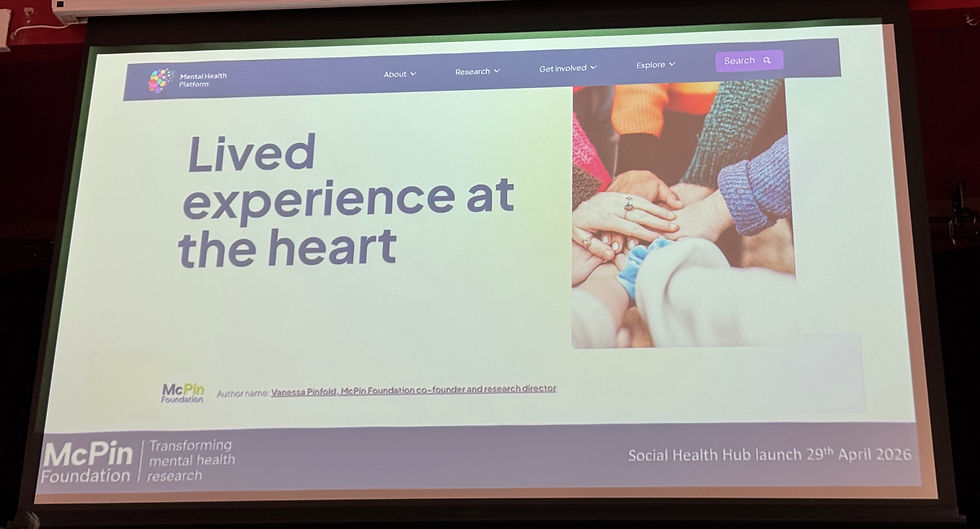
"It's your study, it's my life" was a powerful comment from a lived experience member shared by one of the presenters, highlighting the importance of bringing people with lived experience into research at every stage.
The greatest stand-out from the launch day was the way the researchers have worked so closely with the lived experience advisory panel (LEAP). It was clear there is a trust already established between researchers at the Hub and the LEAP members, an easy rapport suggesting the relationship is truly equal. Indeed, one LEAP member commented the Social Health Hub team are “Embodying the social connections they're researching.”
The positive experiences so far for the LEAP members was shared, with another member saying being part of the group felt like “Turning my pain into purpose”.
What the Hub is planning
The event was a chance for the Social Health Hub researchers to lay out their plans as the research is taking shape.
The three strands of research:
GeoAI for Social Health, linking social indicators with electronic health records.
The Social Health Cohort Study, recruiting 600 participants across England to understand aspects of social connectedness.
Social Health - Policy and Practice, turning research findings into real-world change.
The team shared they’re well underway recruiting people for the ambitious Cohort study, with participants already in all eight locations. The researchers are enthusiastic about getting “Out of the clinic, into the places where people live”, with approaches like the Neighbourhood Tour. This is a cleverly constructed method where a researcher physically joins the participant on a walk around their local area. The researcher presenting this work said it “helps to put the place into somebody's life”, it being so much easier to naturally stimulate conversations around their social connections within the environment.
During a workshop session, attendees discussed the social health of hypothetical individual, before and after an intervention. It was a chance to thread the day of talks together. Mutual respect between researchers and LEAP members was evident as conversations flowed.

Hoping with realism
The team hope to create research which “builds the evidence base for advocacy and policy change”, and more meaningful social prescribing.
Researchers are realistic about what they will achieve over the next few years and want to set honest expectations. They recognise that when applying clinical rigour to social interventions there can be disappointment. Indeed, one previous piece of research presented on social prescribing showed there was great enthusiasm from the participants in the scheme. But, when measuring symptom improvement with things like depression score, the results did not seem to have the desired effect - though still pending final analysis.
This doesn’t mean social prescribing isn’t a good idea, just that there may be barriers still to be addressed. The researchers on the study are investigating what could have made greater changes and already looking to the next project, again involving people with lived experience in the design.
The future
The support from the community for the Social Health Hub means the research has potential for real impact. A member of the LEAP commented: “We really felt the team have integrated our voices, not just added them on – the conversations have never just been about what they need from us.” Taking the time to build this foundation is certain to lead to results which matter to people who are affected by SMI.

Comments